
Operational efficiency is indispensable for competing in the present, but it risks being blind to tomorrow’s market.
BOL transforms Operational Excellence from an end point into the organization’s executive engine, orienting the corporate compass toward sustainable Prosperity.
Connecting Product Excellence with Market Leadership.
The Paradox of Total Efficiency: When Success Becomes a Constraint
Many industrial mid-sized enterprises face crises not due to a lack of efficiency, but because of strategic over-verticalization.
They become extraordinarily capable of optimizing the present, while remaining fatally blind to the weak signals of tomorrow’s market. Improving what is already known is no longer enough.
«An organization that only knows how to improve can become excellent in the past.»
The Three Archetypes of Industrial SMEs: Are You Safe?
The paradox of operational excellence hits companies exactly where they feel strongest.
Technical specialization creates a competitive advantage today, but risks turning into a strategic prison or corporate stagnation.
- OEM (Original Equipment Manufacturer): Risks focusing too much on the product (“How can we make it better?”) while the market is changing the very problem to be solved.
- Tier Supplier: The better they become at serving the existing supply chain, the more vulnerable and dependent they become on the decisions and roadmaps of their large industrial buyers.
- Highly Specialized Manufacturer: The niche can become a prison. Without a market-driven vision, technological heritage remains confined within historical boundaries.
The Prosperity Circuit: Reinvesting Cash Flow
Profitability measures today’s financial results, but Prosperity concerns the organization’s ability to maintain its market relevance over time.
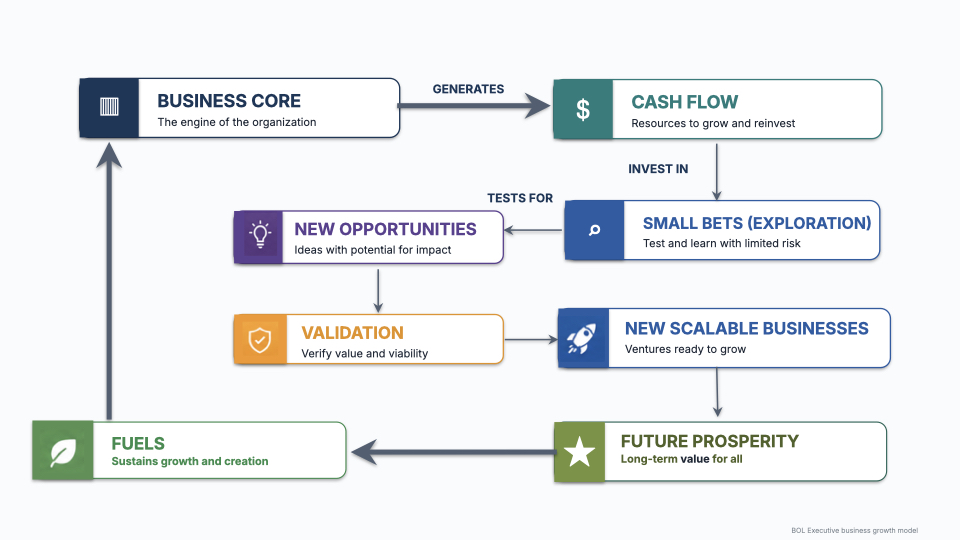
To achieve this, leadership must govern a recursive financial and strategic loop: the cash flow generated by the mature core business must be partially allocated to validate new commercial bets (Small Bets), building the future before the present becomes obsolete.
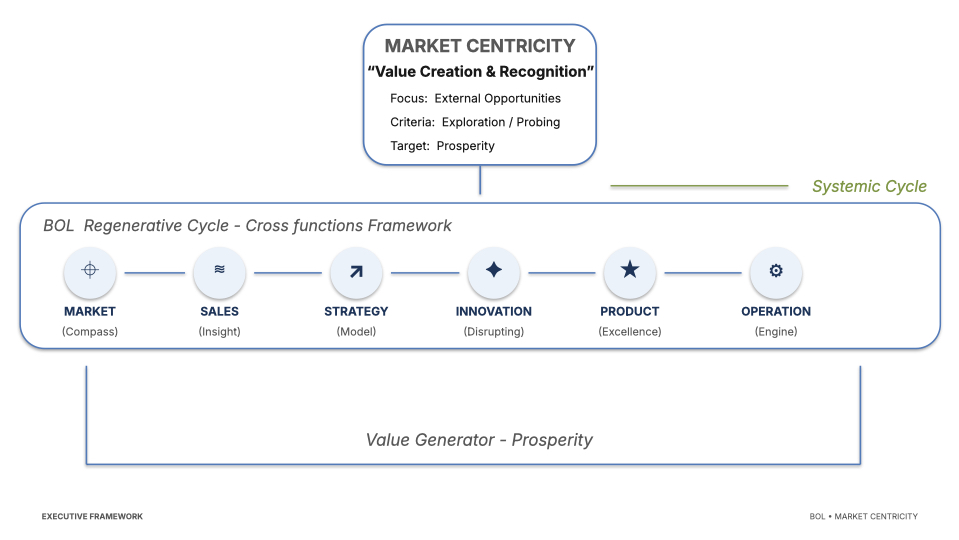
The BOL Regenerative Cycle: A Cross-Functional Strategic Architecture
To break down corporate silos, the BOL framework connects every function into an integrated recursive system:
the market is the COMPASS that guides the route, the sales force gathers iINSIGHTS, STRATEGY defines the model, INNOVATION creates discontinuity, the product expresses excellence, and operations provide the executive ENGINE.
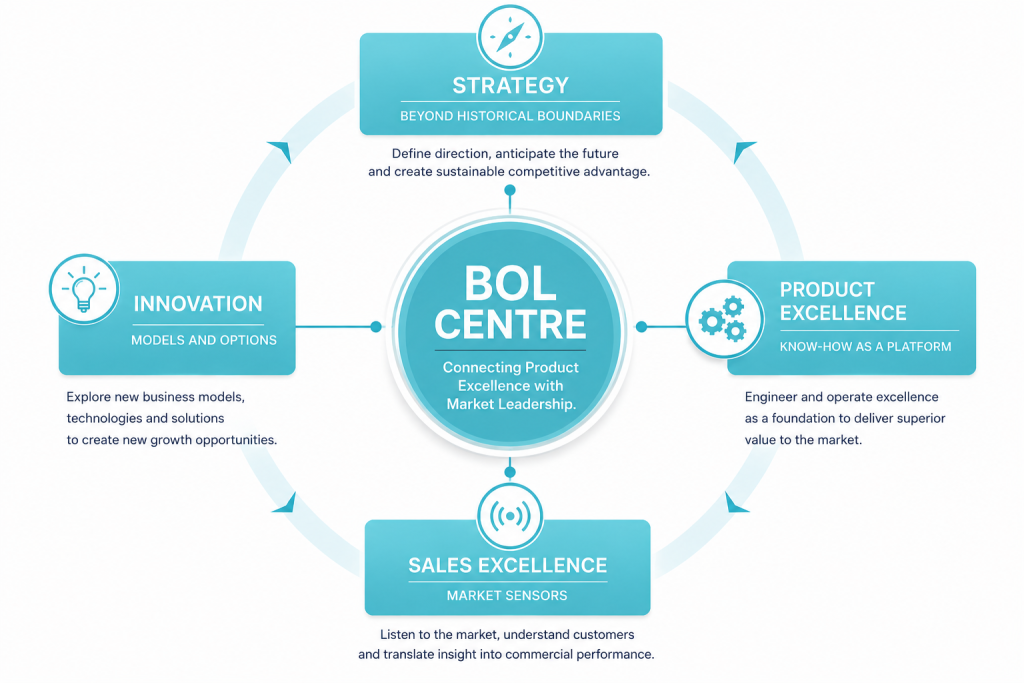
- STRATEGY (Beyond Historical Boundaries): Defines direction by decoding where global value is shifting, establishing not only which arenas to capture, but which opportunities to discard to focus capital.
- INNOVATION (Models and Options): Embraces the redefinition of business models, Go-to-Market channels, and pricing structures, managing future projects with the disciplined logic of Small Bets.
- PRODUCT EXCELLENCE (Know-how as a Platform): Engineering and manufacturing heritage is utilized as a flexible platform of competencies, capable of solving different problems for different customers.
- SALES EXCELLENCE (Market Sensors): The commercial network is structured to act as the primary outside-in sensor of the organization, catching weak signals and competitors’ moves.
From Insight to Execution: The Regenerative Flow
The Framework BOL does not act as a linear chain, but as a continuous systemic cycle.
Each function feeds the next and, simultaneously, receives information from the previous one to eliminate the distance between corporate strategy and global market reality.
This flow is governed by the principle of Market Centricity: the organization shifts its focus from internal manufacturing metrics to external opportunities, steering positioning through three fundamental pillars:
- Focus: Systematic exploration of untapped opportunities.
- Criteria: Continuous validation and market probing before allocating large capital.
- Target: Building defensible Prosperity, superior to short-term profitability alone.
To break down corporate silos, this architecture connects the entire structure into a recursive system: the BOL Regenerative Cycle.
Prosperity Cannot Be Delegated. It Must Be Orchestrated by Leadership.
Every corporate function naturally tends to optimize its own silo: operations seek efficiency, finance seeks control, and sales seek immediate volume growth.
The CEO’s role is to govern the entire system, orchestrating the physiological tensions between today’s Cash Flow and tomorrow’s Prosperity.
Market Centricity does not belong to a single department; it is a strategic leadership choice.
Strategic Collaborations and Executive Programs
- BOL Strategy Audit (The Diagnosis): A targeted intervention (2-4 weeks) designed to calculate the current customer base’s strategic myopia index, map the bottleneck points within the regenerative cycle, and identify latent sustainability risks in the international market.
- BOL Advisory Board (Strategic Partnership): Ongoing board-level advisory dedicated to the Entrepreneur, the Board of Directors, or Private Equity Partners to structure the “two-engine” governance, validate the future portfolio of small bets, and balance capital allocation.
- Global Go-to-Market Redesign: The operational execution of the Framework to guide international expansion, restructure sales channels, and capture strategic opportunities emerging from current global supply chain reorganizations (nearshoring).
BOL Strategy Audit: Quantifying Corporate Strategic Myopia
Optimizing sales channels or allocating capital into new business models requires an objective diagnosis first.
Many leaders confront global markets ignoring the latent threats hidden behind the apparent stability of their current revenue.
The BOL Strategy Audit is a targeted intervention designed to map the organization and quantify three critical vulnerability metrics:
- Tier Lock-in: The real level of dependence on large industrial clients and buyers.
- Niche Trap: Exposure to strategic stagnation, small-scale constraints, and technological commoditization.
- Outside-in Cap: The sales network’s actual capability to act as a global market sensor.
Upon completion, you will receive a preliminary strategic report featuring your company’s positioning within the BOL Regenerative Cycle, identifying the bottlenecks holding back your evolution from pure executive excellence to market leadership.
BOL Strategy Self-Assessment
This self-assessment tool is designed to measure your company’s strategic alignment and resilience against global market shifts.
It is an orientation tool designed exclusively to map growth vectors.
The completion identifies your organization’s positioning within the three maturity profiles of the framework:
Market-Centric Enterprise: Optimizes market-driven executive excellence to ensure global Prosperity.
Functional Imbalance: Presents isolated excellences operating in silos without a continuous regenerative circuit.
Efficiency Trap: Expresses maximum internal efficiency but carries a latent risk of external strategic vulnerability.
By sending your email, you consent to the processing of your data for professional follow-ups, similar to an exchange of business cards. Your data will be treated with the utmost confidentiality and will not be shared with third parties